

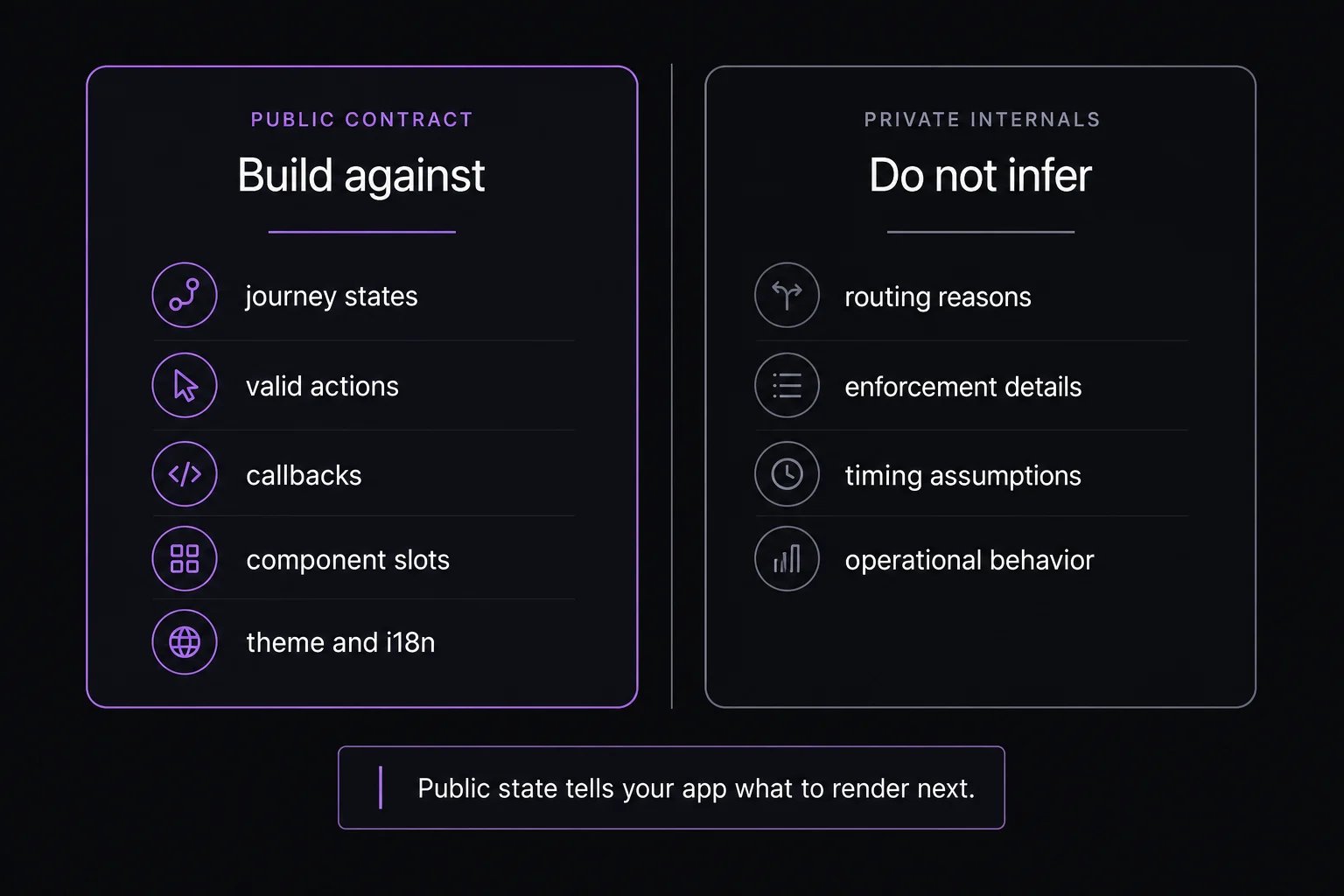
What is public
You can rely on:- Package names, exported SDK APIs, component props, and event names.
- Public journey states such as
ready,routing,gated, androuted. - Public sequence phases such as
unavailable,scheduled,enterable,participating,settling,granted, andended. - Public stage actions on
JourneyView(fromview$), such asstart(),reroute(), andsubmitAccessCode(), and per-phase mechanism actions on the routedSequenceView(viaRoutedView.sequence), such asenter(),bid(),book(),leave(), andclaim(). - Component customization surfaces: theme, variant, slots, render props, callbacks, locale, and translation overrides.
JourneyView (exposed by view$) and the routed SequenceView (reached via RoutedView.sequence). Waitlist is a public scheduled-phase attachment (SequenceView.waitlist), not a separate phase or distribution mechanism; it never grants access on its own.
What is not public
Do not build against or document:- Private routing decisions or why one consumer received a particular path.
- Private abuse-prevention or verification mechanics.
- Internal cache, polling, queueing, retry, or storage implementation details.
- Internal service topology or endpoint behavior not required by the SDK contract.
- Any assumed ordering or timing that is not represented by the public state model.