

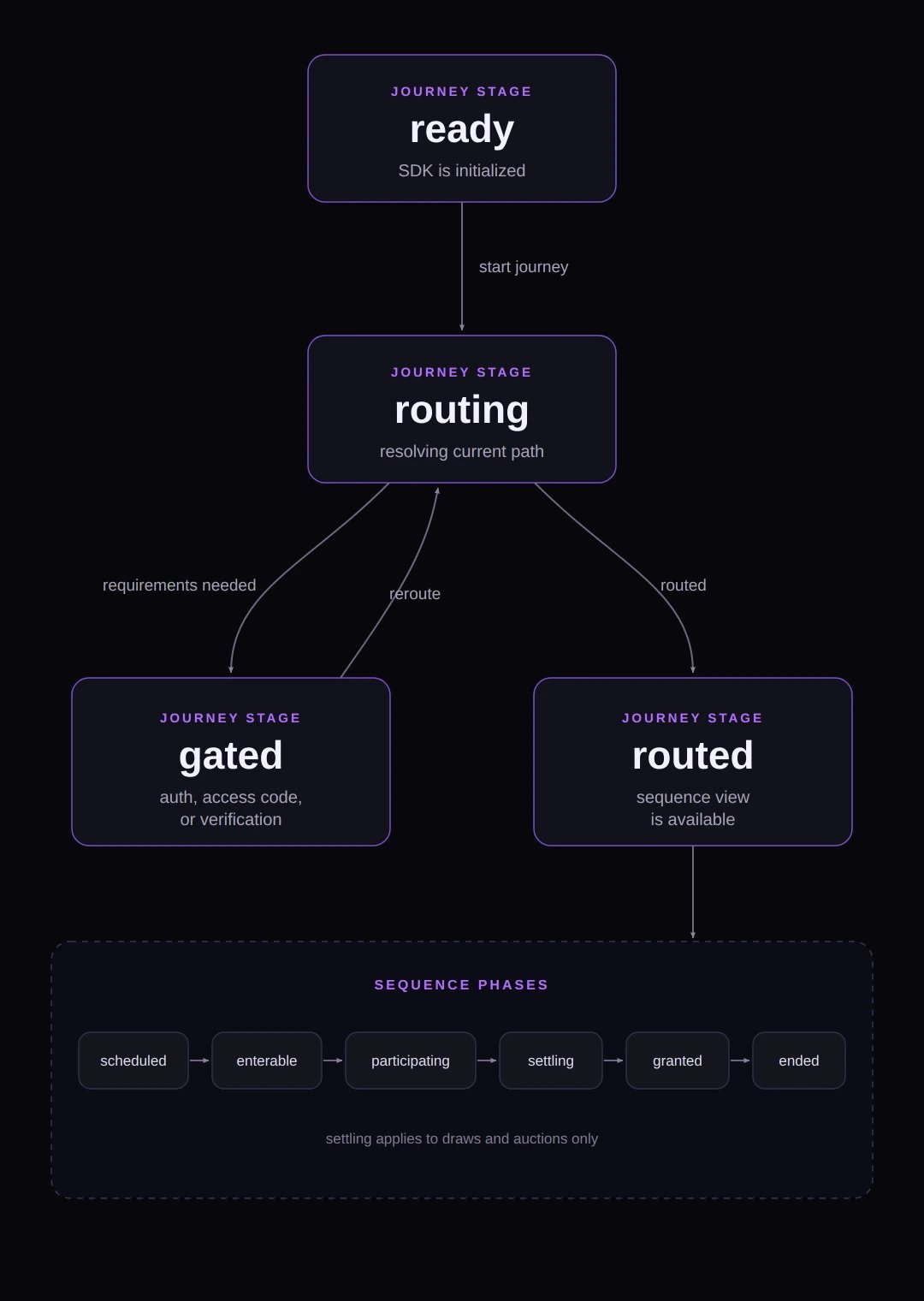
journeyStage: the top-level state of the journey.sequence.phase: the common state inside a routed experience.sequence.mechanism: the consumer path for that phase, such asqueue,draw,auction,appointment, ortimed_release.
waitlist attachment on a scheduled sequence, with join()/leave().
Use view$ first
JourneyView is the primary public UI surface. It exposes only the actions valid for the current state.
snapshot$ when you need raw diagnostic fields, event history, or exhaustive state inspection. Do not drive normal UI from private assumptions about how the snapshot was produced.
Both view$ and snapshot$ are reactive readable stores. Calling .get() reads
the current value once; calling .listen(...) subscribes to future changes and
returns an unsubscribe function. For framework integrations, prefer the adapter’s
state helper where one exists, such as useExperienceJourney in React.
Top-level stages
Routed sequence phases
State-gated actions
Actions are intentionally state-gated. For example:readyexposesstart().gatedexposesreroute(opts?: { accessCode? })andretry(). OmittingaccessCodere-sends the journey’s stored code; passingaccessCode: undefinedexplicitly clears the stored code first.routedexposesreroute()(no arguments — reuses the stored access code),retry(),submitAccessCode(accessCode), and the routedsequenceview.submitAccessCodereturns anAccessCodeSubmitResult; only the"advanced"outcome commits the submitted code as the stored code (see Upgrade offers and access codes).routed.scheduledmay expose awaitlistattachment withwaitlist.join()andwaitlist.leave()while the primary distribution is not yet open.routed.enterableexposesenter()for queue, draw, or timed release;bid(amount)for auction; orbook(slotId, locationId?)for appointment.routed.participatingexposes mechanism-specific actions such asleave(),bid(amount),complete(),cancel(reason?), orreschedule(newSlotId, newLocationId?).routed.grantedexposesclaim()and the activegrant.claim()returns theAdmissionGrantsynchronously, marks checkout as started, and stops the client-side grant-expiry and capability-refresh timers so the server reservation owns the deadline. An unclaimed grant lapses toendedwith anexpiredoutcome.routed.endeddoes not expose sequence actions.
Waitlist attachment
A waitlist is not a mechanism or a phase. It is an optional attachment that appears on ascheduled sequence while the primary distribution has not yet opened. When present, sequence.waitlist exposes:
status: one of"not_waitlisted","waitlisted", or"notified".join(): join the scheduled distribution’s waitlist.leave(): leave the scheduled distribution’s waitlist.
"notified" status is restored only from /consumers/me.
Upgrade offers and access codes
Arouted view can carry gated upgrade offers and accept an access code to attempt an upgrade:
offers: the gated sequences the consumer could route to. They are informational until a reroute or access code selects one.submitAccessCode(accessCode): a single-shot, stateless upgrade attempt. It returns anAccessCodeSubmitResult:{ outcome: "advanced"; sequenceId }: the code unlocked a higher-priority offered sequence; the journey moved into it and the code became the stored code.{ outcome: "unchanged" }: the code unlocked nothing; the journey stays in its current sequence and the stored code is untouched.{ outcome: "gated" }: routing no longer yields an admissible sequence; the journey is now gated and the gate UI should take over.
"advanced" outcome commits the submitted code. A rejected code never displaces the stored code or the current participation. This routed upgrade flow is distinct from the gated-stage reroute({ accessCode }) flow.
Sequence-change events
When the routed sequence changes, the SDK emits areroute journey event. Its detail.direction is one of "upgrade", "downgrade", "lateral", or "unknown". A downgrade surfaces as a reroute event with severity "warning" and the message "Sequence downgraded"; other changes use severity "info" and "Sequence changed". The direction is event-level diagnostic context, not a field on the view.