

Webhooks Guide
Learn how to receive and process Fanfare webhooks for real-time event notifications.Overview
Fanfare webhooks notify your server when events occur in your experiences. Use webhooks to synchronize data, trigger workflows, and respond to consumer actions in real-time. What you’ll learn:- Setting up webhook endpoints
- Verifying webhook signatures
- Handling different event types
- Implementing retry logic
- Best practices for reliability
Prerequisites
- Fanfare account with API access
- Server capable of receiving HTTP POST requests
- Understanding of webhook patterns
- HTTPS endpoint (required for production)
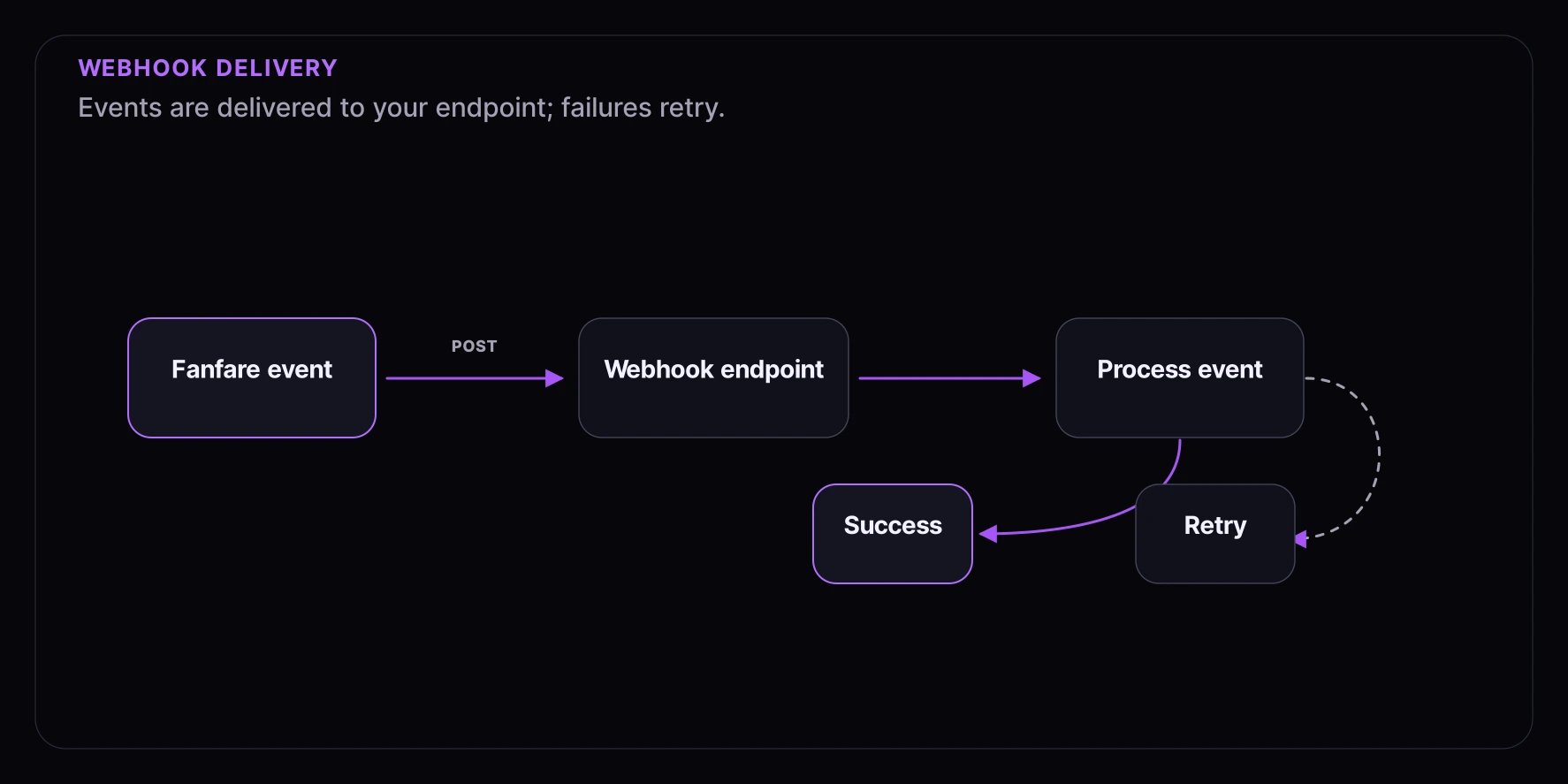
Webhook Architecture
Step 1: Configure Webhooks
Admin Dashboard Setup
- Navigate to Settings > Webhooks in the Fanfare admin
- Click Add Endpoint
- Enter your endpoint URL (must be HTTPS)
- Select events to subscribe to
- Copy the signing secret
API Configuration
async function createWebhookEndpoint() {
  const response = await fetch("https://admin.fanfare.io/api/webhooks", {
    method: "POST",
    headers: {
      Authorization: `Bearer ${process.env.FANFARE_SECRET_KEY}`,
      "Content-Type": "application/json",
    },
    body: JSON.stringify({
      url: "https://your-server.com/webhooks/fanfare",
      events: [
        "queue.consumer_entered",
        "queue.consumer_admitted",
        "queue.consumer_left",
        "queue.admission_completed",
        "queue.admission_expired",
        "draw.entry_created",
        "draw.winners_selected",
        "draw.prize_claimed",
        "auction.bid_placed",
        "auction.auction_ended",
        "auction.winner_notified",
        "experience.started",
        "experience.ended",
        "experience.paused",
        "experience.resumed",
        "consumer.authenticated",
        "consumer.linked",
      ],
      description: "Main production webhook endpoint",
      enabled: true,
    }),
  });

  if (!response.ok) {
    throw new Error("Unable to create webhook endpoint");
  }

  return response.json();
}
Step 2: Create Webhook Handler
Express.js Handler
// routes/webhooks/fanfare.ts
import express from "express";
import crypto from "crypto";

const router = express.Router();
const WEBHOOK_SECRET = process.env.FANFARE_WEBHOOK_SECRET!;

// Middleware to capture raw body for signature verification
router.use(
  express.json({
    verify: (req, res, buf) => {
      (req as { rawBody?: Buffer }).rawBody = buf;
    },
  })
);

// Verify webhook signature
function verifySignature(payload: string | Buffer, signature: string): boolean {
  const timestamp = signature.split(",")[0]?.split("=")[1];
  const receivedSig = signature.split(",")[1]?.split("=")[1];

  if (!timestamp || !receivedSig) {
    return false;
  }

  // Check timestamp is within 5 minutes
  const timestampAge = Math.abs(Date.now() - parseInt(timestamp) * 1000);
  if (timestampAge > 5 * 60 * 1000) {
    console.warn("Webhook timestamp too old:", timestampAge);
    return false;
  }

  // Compute expected signature
  const signedPayload = `${timestamp}.${payload}`;
  const expectedSig = crypto.createHmac("sha256", WEBHOOK_SECRET).update(signedPayload).digest("hex");

  // Constant-time comparison
  return crypto.timingSafeEqual(Buffer.from(receivedSig), Buffer.from(expectedSig));
}

router.post("/", async (req, res) => {
  const signature = req.headers["x-fanfare-signature"] as string;
  const rawBody = (req as { rawBody?: Buffer }).rawBody?.toString() || "";

  // Verify signature
  if (!signature || !verifySignature(rawBody, signature)) {
    console.error("Invalid webhook signature");
    return res.status(401).json({ error: "Invalid signature" });
  }

  const event = req.body;

  // Acknowledge receipt immediately
  res.status(200).json({ received: true });

  // Process event asynchronously
  try {
    await processWebhookEvent(event);
  } catch (error) {
    console.error("Webhook processing error:", error);
    // Event already acknowledged - log for monitoring
  }
});

export default router;
Next.js API Route Handler
// pages/api/webhooks/fanfare.ts (Next.js Pages Router)
import { NextApiRequest, NextApiResponse } from "next";
import crypto from "crypto";

export const config = {
  api: {
    bodyParser: false,
  },
};

async function getRawBody(req: NextApiRequest): Promise<string> {
  const chunks: Buffer[] = [];
  for await (const chunk of req) {
    chunks.push(typeof chunk === "string" ? Buffer.from(chunk) : chunk);
  }
  return Buffer.concat(chunks).toString("utf8");
}

export default async function handler(req: NextApiRequest, res: NextApiResponse) {
  if (req.method !== "POST") {
    return res.status(405).json({ error: "Method not allowed" });
  }

  const rawBody = await getRawBody(req);
  const signature = req.headers["x-fanfare-signature"] as string;

  if (!verifySignature(rawBody, signature)) {
    return res.status(401).json({ error: "Invalid signature" });
  }

  const event = JSON.parse(rawBody);

  // Acknowledge immediately
  res.status(200).json({ received: true });

  // Process asynchronously
  await processWebhookEvent(event);
}

function verifySignature(payload: string, signature: string): boolean {
  const WEBHOOK_SECRET = process.env.FANFARE_WEBHOOK_SECRET!;

  const timestamp = signature.split(",")[0]?.split("=")[1];
  const receivedSig = signature.split(",")[1]?.split("=")[1];

  if (!timestamp || !receivedSig) return false;

  const signedPayload = `${timestamp}.${payload}`;
  const expectedSig = crypto.createHmac("sha256", WEBHOOK_SECRET).update(signedPayload).digest("hex");

  return crypto.timingSafeEqual(Buffer.from(receivedSig), Buffer.from(expectedSig));
}
Step 3: Process Webhook Events
Event Processor
// services/webhook-processor.ts
interface WebhookEvent {
  id: string;
  type: string;
  created: number;
  data: Record<string, unknown>;
  organizationId: string;
  experienceId?: string;
}

export async function processWebhookEvent(event: WebhookEvent) {
  // Idempotency check
  const processed = await db.query.webhookEvents.findFirst({
    where: eq(webhookEvents.eventId, event.id),
  });

  if (processed) {
    console.log("Event already processed:", event.id);
    return;
  }

  // Record event receipt
  await db.insert(webhookEvents).values({
    eventId: event.id,
    eventType: event.type,
    receivedAt: new Date(),
    status: "processing",
  });

  try {
    // Route to appropriate handler
    await routeWebhookEvent(event);

    // Mark as processed
    await db
      .update(webhookEvents)
      .set({ status: "completed", processedAt: new Date() })
      .where(eq(webhookEvents.eventId, event.id));
  } catch (error) {
    // Mark as failed
    await db
      .update(webhookEvents)
      .set({
        status: "failed",
        error: error instanceof Error ? error.message : "Unknown error",
      })
      .where(eq(webhookEvents.eventId, event.id));

    throw error;
  }
}

async function routeWebhookEvent(event: WebhookEvent) {
  const handlers: Record<string, (data: WebhookEvent["data"]) => Promise<void>> = {
    // Queue events
    "queue.consumer_entered": handleConsumerEntered,
    "queue.consumer_admitted": handleConsumerAdmitted,
    "queue.consumer_left": handleConsumerLeft,
    "queue.admission_completed": handleAdmissionCompleted,
    "queue.admission_expired": handleAdmissionExpired,

    // Draw events
    "draw.entry_created": handleDrawEntry,
    "draw.winners_selected": handleWinnersSelected,
    "draw.prize_claimed": handlePrizeClaimed,

    // Auction events
    "auction.bid_placed": handleBidPlaced,
    "auction.auction_ended": handleAuctionEnded,

    // Experience events
    "experience.started": handleExperienceStarted,
    "experience.ended": handleExperienceEnded,

    // Consumer events
    "consumer.authenticated": handleConsumerAuthenticated,
    "consumer.linked": handleConsumerLinked,
  };

  const handler = handlers[event.type];
  if (!handler) {
    console.warn("Unhandled webhook event type:", event.type);
    return;
  }

  await handler(event.data);
}
Event Handlers
// handlers/queue-events.ts

interface ConsumerAdmittedData {
  consumerId: string;
  experienceId: string;
  distributionId: string;
  admissionToken: string;
  admittedAt: string;
  expiresAt: string;
  position: number;
  waitTimeSeconds: number;
}

async function handleConsumerAdmitted(data: ConsumerAdmittedData) {
  const { consumerId, experienceId, distributionId, admissionToken, expiresAt } = data;

  // Store admission record
  await db.insert(admissions).values({
    consumerId,
    experienceId,
    distributionId,
    token: admissionToken,
    expiresAt: new Date(expiresAt),
    status: "active",
  });

  // Get consumer contact info
  const consumer = await db.query.consumers.findFirst({
    where: eq(consumers.id, consumerId),
  });

  // Send notification
  if (consumer?.email) {
    await sendEmail({
      to: consumer.email,
      subject: "You're in! Complete your purchase",
      template: "admission-granted",
      data: {
        expiresAt: new Date(expiresAt).toLocaleString(),
        checkoutUrl: "https://your-store.com/checkout",
      },
    });
  }

  // Track analytics
  await analytics.track("admission_granted", {
    consumerId,
    experienceId,
    waitTime: data.waitTimeSeconds,
  });
}

interface AdmissionCompletedData {
  consumerId: string;
  experienceId: string;
  distributionId: string;
  orderId?: string;
  completedAt: string;
}

async function handleAdmissionCompleted(data: AdmissionCompletedData) {
  const { consumerId, experienceId, orderId, completedAt } = data;

  // Update admission status
  await db
    .update(admissions)
    .set({
      status: "completed",
      completedAt: new Date(completedAt),
      orderId,
    })
    .where(and(eq(admissions.consumerId, consumerId), eq(admissions.experienceId, experienceId)));

  // Track conversion
  await analytics.track("admission_converted", {
    consumerId,
    experienceId,
    orderId,
  });
}

interface AdmissionExpiredData {
  consumerId: string;
  experienceId: string;
  distributionId: string;
  expiredAt: string;
}

async function handleAdmissionExpired(data: AdmissionExpiredData) {
  const { consumerId, experienceId, expiredAt } = data;

  // Update admission status
  await db
    .update(admissions)
    .set({
      status: "expired",
      expiredAt: new Date(expiredAt),
    })
    .where(and(eq(admissions.consumerId, consumerId), eq(admissions.experienceId, experienceId)));

  // Release any reserved inventory
  await releaseReservations(consumerId, experienceId);

  // Track abandonment
  await analytics.track("admission_expired", {
    consumerId,
    experienceId,
  });
}
Draw Event Handlers
// handlers/draw-events.ts

interface WinnersSelectedData {
  drawId: string;
  experienceId: string;
  winners: Array<{
    consumerId: string;
    position: number;
    claimToken: string;
    claimDeadline: string;
  }>;
  totalEntries: number;
  selectionMethod: string;
}

async function handleWinnersSelected(data: WinnersSelectedData) {
  const { drawId, winners, totalEntries } = data;

  // Store winners
  for (const winner of winners) {
    await db.insert(drawWinners).values({
      drawId,
      consumerId: winner.consumerId,
      position: winner.position,
      claimToken: winner.claimToken,
      claimDeadline: new Date(winner.claimDeadline),
      status: "pending_claim",
    });

    // Get consumer and send notification
    const consumer = await db.query.consumers.findFirst({
      where: eq(consumers.id, winner.consumerId),
    });

    if (consumer) {
      await sendWinnerNotification(consumer, winner, drawId);
    }
  }

  // Track draw completion
  await analytics.track("draw_completed", {
    drawId,
    winnerCount: winners.length,
    totalEntries,
  });
}
Step 4: Handle Failures and Retries
Retry Logic
Fanfare automatically retries failed webhooks with exponential backoff:| Attempt | Delay |
|---|---|
| 1 | Immediate |
| 2 | 1 minute |
| 3 | 5 minutes |
| 4 | 30 minutes |
| 5 | 2 hours |
| 6 | 8 hours |
Handling Retries in Your Code
// Ensure idempotency
async function processWebhookIdempotent(event: WebhookEvent) {
  const lockKey = `webhook:${event.id}`;

  // Try to acquire distributed lock
  const acquired = await redis.set(lockKey, "1", "EX", 300, "NX");
  if (!acquired) {
    console.log("Event already being processed:", event.id);
    return;
  }

  try {
    // Check if already processed
    const existing = await db.query.webhookEvents.findFirst({
      where: eq(webhookEvents.eventId, event.id),
    });

    if (existing?.status === "completed") {
      return;
    }

    await processWebhookEvent(event);
  } finally {
    await redis.del(lockKey);
  }
}
Dead Letter Queue
// Handle events that fail repeatedly
async function handleFailedWebhook(event: WebhookEvent, error: Error) {
  // Store in dead letter queue
  await db.insert(webhookDeadLetterQueue).values({
    eventId: event.id,
    eventType: event.type,
    payload: JSON.stringify(event),
    error: error.message,
    failedAt: new Date(),
    retryCount: 0,
  });

  // Alert operations team
  await sendAlert({
    type: "webhook_failure",
    eventId: event.id,
    eventType: event.type,
    error: error.message,
  });
}

// Periodic job to retry dead letter queue
async function processDeadLetterQueue() {
  const deadLetters = await db.query.webhookDeadLetterQueue.findMany({
    where: and(
      lt(webhookDeadLetterQueue.retryCount, 3),
      lt(webhookDeadLetterQueue.failedAt, new Date(Date.now() - 3600000))
    ),
    limit: 10,
  });

  for (const item of deadLetters) {
    try {
      const event = JSON.parse(item.payload);
      await processWebhookEvent(event);

      // Remove from dead letter queue
      await db.delete(webhookDeadLetterQueue).where(eq(webhookDeadLetterQueue.id, item.id));
    } catch (error) {
      // Increment retry count
      await db
        .update(webhookDeadLetterQueue)
        .set({ retryCount: item.retryCount + 1 })
        .where(eq(webhookDeadLetterQueue.id, item.id));
    }
  }
}
Step 5: Testing Webhooks
Local Development with Tunnels
# Using ngrok
ngrok http 3000

# Using cloudflared
cloudflared tunnel --url http://localhost:3000
Test Webhook Delivery
// Admin API: Trigger test webhook
async function sendTestWebhook(endpointId: string, eventType: string) {
  await adminClient.webhooks.sendTest(endpointId, {
    eventType,
    data: {
      consumerId: "test_consumer_123",
      experienceId: "test_experience_456",
      // ... test data
    },
  });
}

// Verify endpoint health
async function verifyWebhookEndpoint(endpointId: string) {
  const status = await adminClient.webhooks.verify(endpointId);
  console.log("Endpoint status:", status);
  // { healthy: true, lastDelivery: "2024-01-15T10:30:00Z", successRate: 0.99 }
}
Unit Testing Handlers
// tests/webhook-handlers.test.ts
import { handleConsumerAdmitted } from "../handlers/queue-events";

describe("handleConsumerAdmitted", () => {
  it("should store admission and send notification", async () => {
    const mockData = {
      consumerId: "consumer_123",
      experienceId: "exp_456",
      distributionId: "dist_789",
      admissionToken: "token_abc",
      admittedAt: new Date().toISOString(),
      expiresAt: new Date(Date.now() + 600000).toISOString(),
      position: 1,
      waitTimeSeconds: 120,
    };

    await handleConsumerAdmitted(mockData);

    // Verify admission stored
    const admission = await db.query.admissions.findFirst({
      where: eq(admissions.consumerId, mockData.consumerId),
    });

    expect(admission).toBeDefined();
    expect(admission?.status).toBe("active");

    // Verify email sent
    expect(mockEmailService.sendEmail).toHaveBeenCalledWith(
      expect.objectContaining({
        template: "admission-granted",
      })
    );
  });
});
Event Reference
Queue Events
| Event | Description | Key Data |
|---|---|---|
queue.consumer_entered | Consumer joined queue | consumerId, position |
queue.consumer_admitted | Consumer reached front | admissionToken, expiresAt |
queue.consumer_left | Consumer left queue | consumerId, reason |
queue.admission_completed | Purchase completed | orderId |
queue.admission_expired | Admission window closed | expiredAt |
Draw Events
| Event | Description | Key Data |
|---|---|---|
draw.entry_created | New draw entry | consumerId, entryNumber |
draw.winners_selected | Draw completed | winners[], totalEntries |
draw.prize_claimed | Winner claimed prize | consumerId, orderId |
draw.prize_expired | Claim window closed | consumerId, expiresAt |
Auction Events
| Event | Description | Key Data |
|---|---|---|
auction.bid_placed | New bid received | consumerId, amount |
auction.outbid | Consumer was outbid | consumerId, newHighBid |
auction.auction_ended | Auction completed | winnerId, finalBid |
auction.winner_notified | Winner notified | consumerId |
Experience Events
| Event | Description | Key Data |
|---|---|---|
experience.started | Experience went live | experienceId, type |
experience.ended | Experience concluded | totalParticipants |
experience.paused | Experience paused | reason |
experience.resumed | Experience resumed | pausedDuration |
Best Practices
1. Acknowledge Quickly
// Good: Acknowledge then process
router.post("/", async (req, res) => {
  // Verify signature first
  if (!verifySignature(req)) {
    return res.status(401).end();
  }

  // Acknowledge immediately
  res.status(200).json({ received: true });

  // Process asynchronously
  processWebhookEvent(req.body).catch(console.error);
});

// Bad: Process then acknowledge
router.post("/", async (req, res) => {
  await processWebhookEvent(req.body); // May timeout
  res.status(200).json({ received: true });
});
2. Handle Out-of-Order Events
// Events may arrive out of order
async function handleWithOrdering(event: WebhookEvent) {
  const timestamp = event.created;

  // Check if we have a newer event already
  const existing = await db.query.eventState.findFirst({
    where: eq(eventState.entityId, event.data.consumerId),
  });

  if (existing && existing.lastEventTimestamp > timestamp) {
    console.log("Ignoring out-of-order event");
    return;
  }

  // Process and update timestamp
  await processEvent(event);
  await db
    .update(eventState)
    .set({ lastEventTimestamp: timestamp })
    .where(eq(eventState.entityId, event.data.consumerId));
}
3. Monitor Webhook Health
// Track webhook metrics
async function recordWebhookMetrics(event: WebhookEvent, processingTime: number, success: boolean) {
  await metrics.record("webhook_processed", {
    eventType: event.type,
    success,
    processingTimeMs: processingTime,
  });

  // Alert on high failure rate
  const recentFailures = await getRecentFailureCount(event.type);
  if (recentFailures > 10) {
    await sendAlert({
      type: "webhook_failures_high",
      eventType: event.type,
      failureCount: recentFailures,
    });
  }
}
Troubleshooting
Signature Verification Failing
- Ensure you’re using the raw request body
- Check webhook secret is correct
- Verify timestamp is within acceptable range
Events Not Being Received
- Check endpoint URL is publicly accessible
- Verify HTTPS certificate is valid
- Review Fanfare webhook delivery logs
- Check firewall rules
Duplicate Events
- Implement idempotency checks
- Use event IDs for deduplication
- Check for distributed lock issues
What’s Next
- Real-time Updates - Client-side real-time data
- Error Handling - Comprehensive error management
- Custom Platform - Full integration guide