

How Draws Work
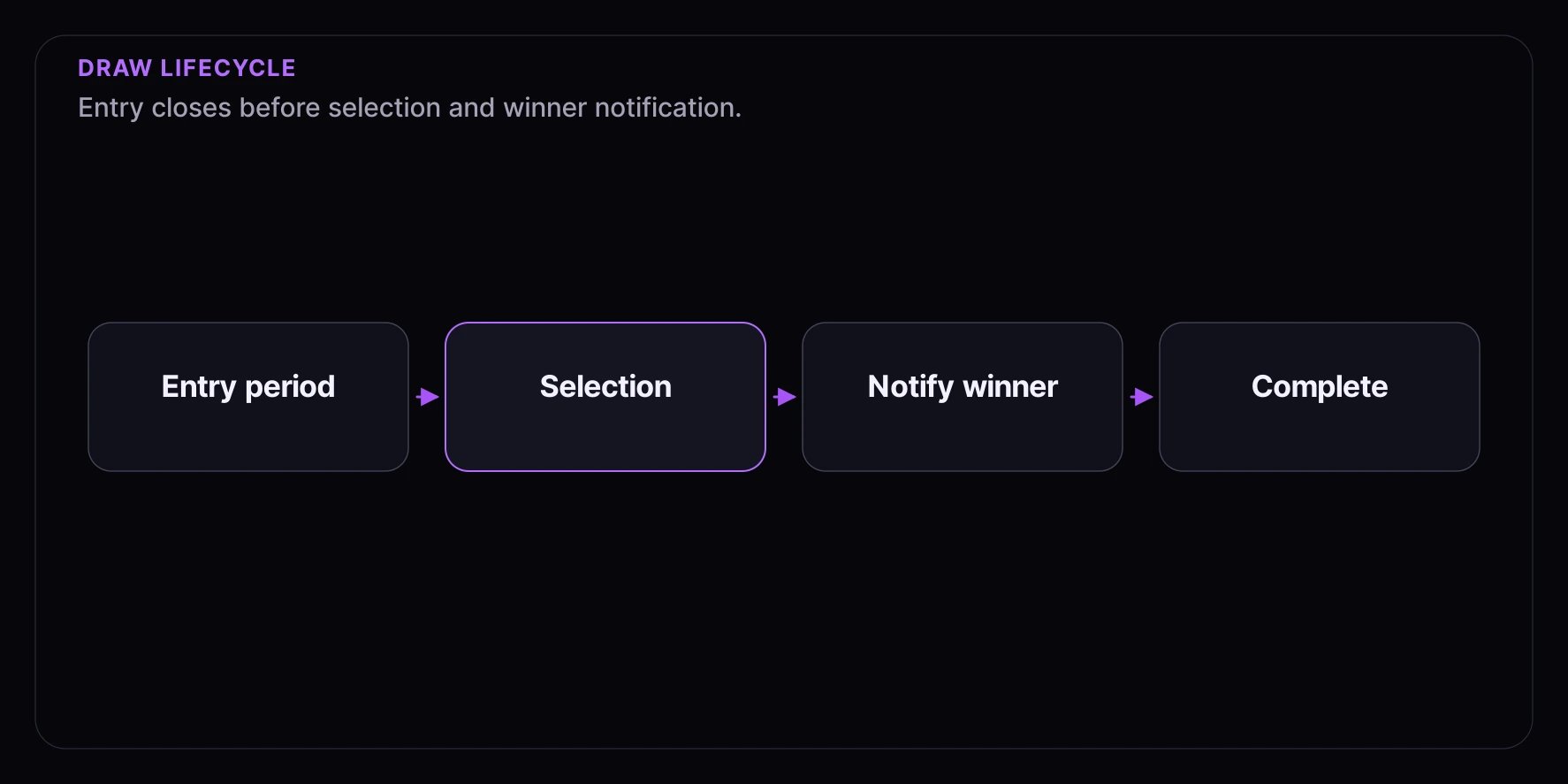
Entry Period
- Draw opens at the scheduled start time
- Consumers enter the draw (one active entry per consumer)
- Entries accumulate until the draw time
- No queue position; standard draws give all entries equal chance
Selection Event
- At draw time, the system randomly selects winners
- Winners receive a checkout link with a time limit
- Non-winners are notified of the result
Completion Phase
- Winners have a limited time window to complete their purchase
- If enabled, expired winners can be replaced with new selections from the remaining pool
- Draw closes when all spots are filled or the end time is reached
The Consumer Experience
Before the Draw
Consumers see:- Entry confirmation message
- Countdown to draw time
- Total number of entries (optional)
- Their odds if displayed for a standard draw
At Draw Time
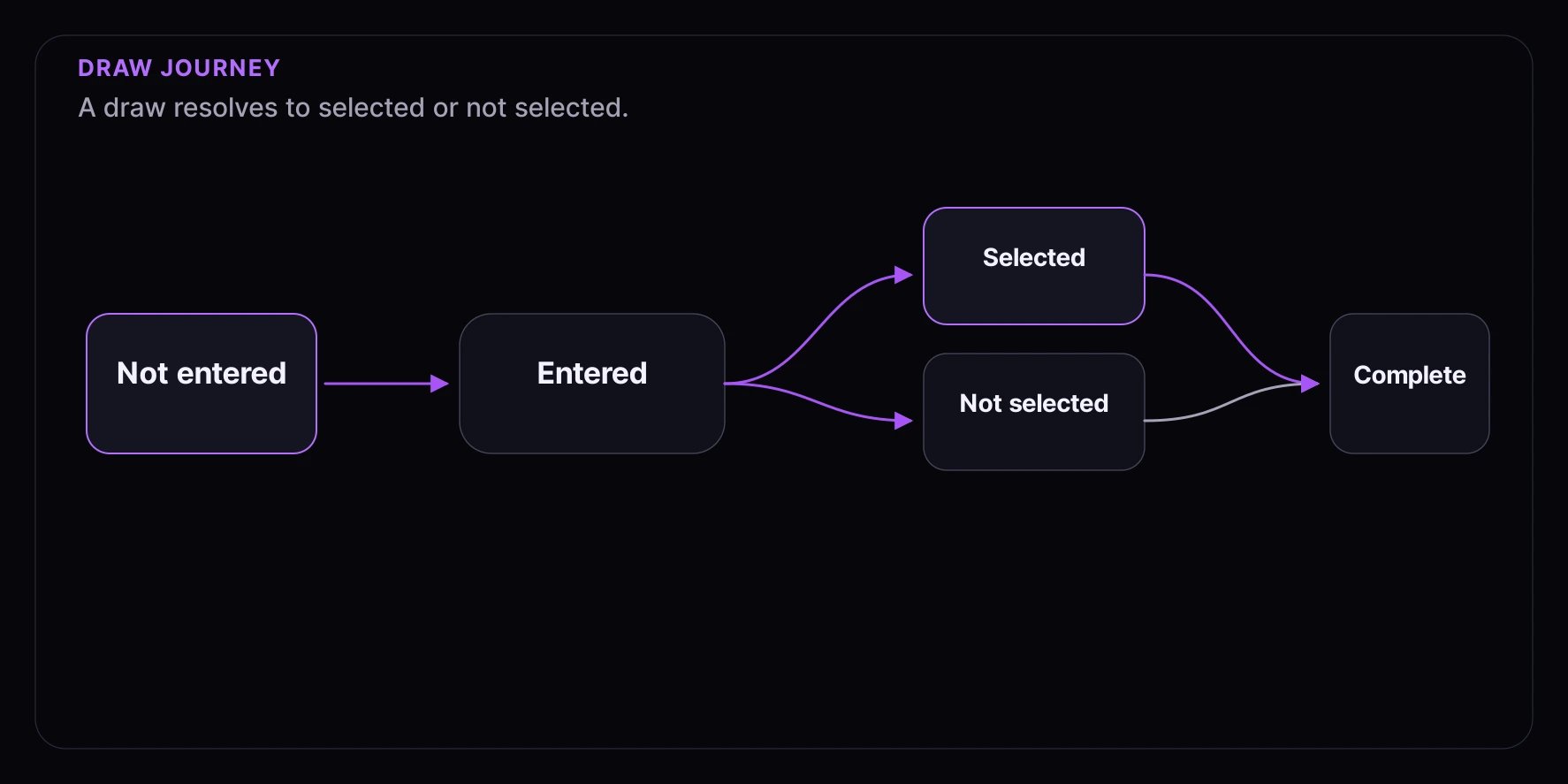
If selected (Won):- Congratulations notification
- Link to complete purchase
- Time remaining to complete (countdown)
- Friendly “not selected this time” message
- Optional: Information about future opportunities
After Winning
Winners have a time window to complete their purchase. If they don’t complete in time:- Their spot may go to another entrant (if backfill is enabled)
- They receive a “time expired” notification
Consumer Journey
When to Use Draws
Configuration Options
Winner Count
How many winners to select from the entry pool:- Set winner count equal to your available inventory (e.g., 100 items = 100 winners)
- If fewer people enter than winner count, everyone wins
- Handling non-completion: Enable “Backfill” to automatically select replacement winners when someone doesn’t complete their purchase, rather than selecting extra winners upfront
Entry Window
Control when entries are accepted using open and close times:- Open time: When entries start being accepted
- Close time: When entries stop (typically at draw time)
- A shorter window creates urgency; a longer window maximizes participation
Winner Time Window
How long winners have to complete their purchase:- Short (15-30 minutes): High-demand items, creates urgency
- Medium (1-4 hours): Standard purchases
- Long (24 hours): Accessible for different time zones
Backfill on Non-Completion
When enabled, if a winner doesn’t complete in time:- A new winner is selected from remaining entrants
- Backfill continues until the winner count is completed, the draw closes, or the entry pool is exhausted
- Useful for ensuring all inventory gets sold
Loyalty-Biased Selection
Enable loyalty-biased selection only when the draw should recognize loyalty or engagement as part of the promotion. It does not guarantee a win and should not be described as a fixed chance of selection. When this setting is enabled:- Tell consumers that loyalty may improve opportunity, not that it guarantees an outcome.
- Keep draw result messaging simple: entered, selected, not selected, or expired.
- Review promotion, fairness, and eligibility language before launch.
Best Practices
1. Choose an Entry Window That Fits Your Launch
Entry window length depends on your launch type:- Standard launches (3-7 days): Gives consumers time to discover and enter
- Hyped drops (1-4 hours): Creates urgency for highly anticipated releases
- Sneaker-style (15 minutes to 1 hour): Short, focused windows for trained audiences
2. Communicate Draw Time Clearly
Consumers should know exactly when results are announced:- Show countdown to draw time
- Send reminder before draw
- Notify immediately when drawn
3. Require Verified Accounts
For valuable draws, prevent duplicate entries:- Require account creation before entry
- Use verified consumer level for high-value items
4. Give Winners Reasonable Time
Balance urgency with accessibility:- High-value, limited items: 1 hour
- Standard items: 24 hours
- International audience: Consider time zones
5. Set Appropriate Expectations
Be transparent about odds:- Show entry count if helpful
- Communicate winner count
- Let consumers know when to expect results
- Avoid fixed-odds language when loyalty-biased selection is enabled
Common Patterns
Sneaker Drop Draw
- Entry window: 1 hour (short, focused)
- Winner time: 15 minutes (high urgency)
- Backfill: Enabled (ensures sell-out)
- Authentication: Verified consumers only
Presale Draw
- Entry window: 2 weeks (build anticipation)
- Winner time: 24 hours (accessible)
- Backfill: Enabled
- Authentication: Registered consumers
Tiered Draw (VIP + General)
Create separate access paths for different consumer groups: VIP Path:- Smaller entry pool (VIP consumers only)
- Higher win rate (e.g., 50 winners from 200 entries = 25% odds)
- Larger entry pool (everyone else)
- Lower win rate (e.g., 200 winners from 10,000 entries = 2% odds)
How Selection Works
Fanfare draws use randomized selection. For standard draws, every entry has an equal chance:- Equal opportunity — Each entry has the same chance of being selected in a standard draw
- Automated — The system handles selection without manual intervention
- Transparent — Winners are notified immediately; non-winners are informed of the result
Related Concepts
- Distributions Overview — Common distribution concepts
- Queue Distribution — First-come, first-served alternative
- Auction Distribution — Price-based allocation alternative
- Appointment Distribution — Time-slot booking
- Timed Release Distribution — Instant access at scheduled time
- Waitlist Distribution — Interest capture and notifications
- Audiences — Tiered access for draws